
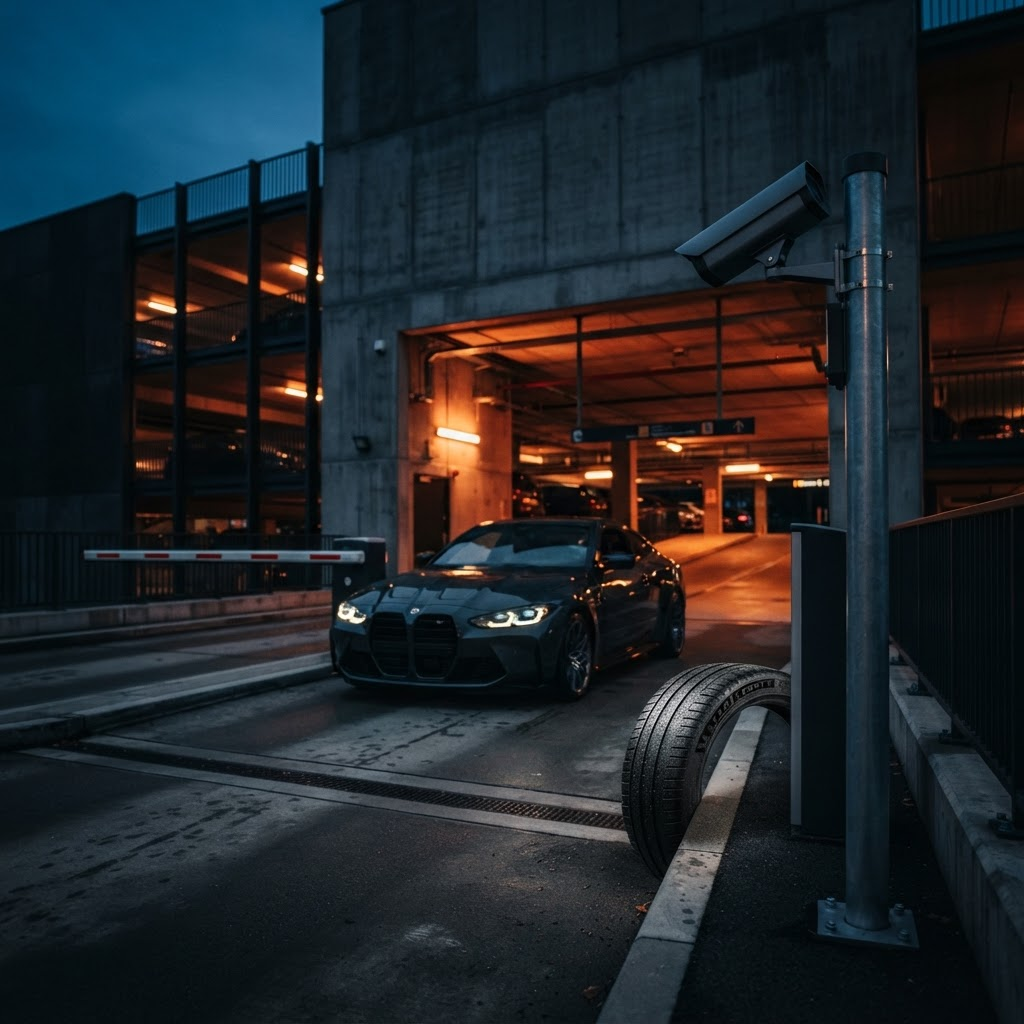
Computer Vision for Parking Entrances
Every studded tire. Caught at the gate. Automatically.
Stud Striker AI reads each vehicle as it reaches the entry lane and decides — studded or not — in a second or two, with high confidence. Field-tested through real winter conditions, and proven integrating with major parking hardware to drop the arm and post a message on your existing lane screens.
Studded tires quietly cost your property every winter.
Studded tires tear up asphalt, concrete ramps, and painted deck surfaces faster than any other factor under a property manager's control. Most garages catch it the hard way — after the damage.
Pavement cost
Studs accelerate rutting and resurfacing cycles on ramps and drive lanes. The resurfacing bill lands on your budget, season after season.
Labor cost
Manual inspection means a person at every lane, every shift — a cost that scales with your hours of operation, not your traffic.
Liability
Without a timestamped record, a bylaw dispute or insurance claim has nothing to point to. A verbal check leaves no trail.
One camera at the lane. A decision in a second or two.
- 01
Capture
A fixed or streaming camera watches the entry lane continuously.
- 02
Detect
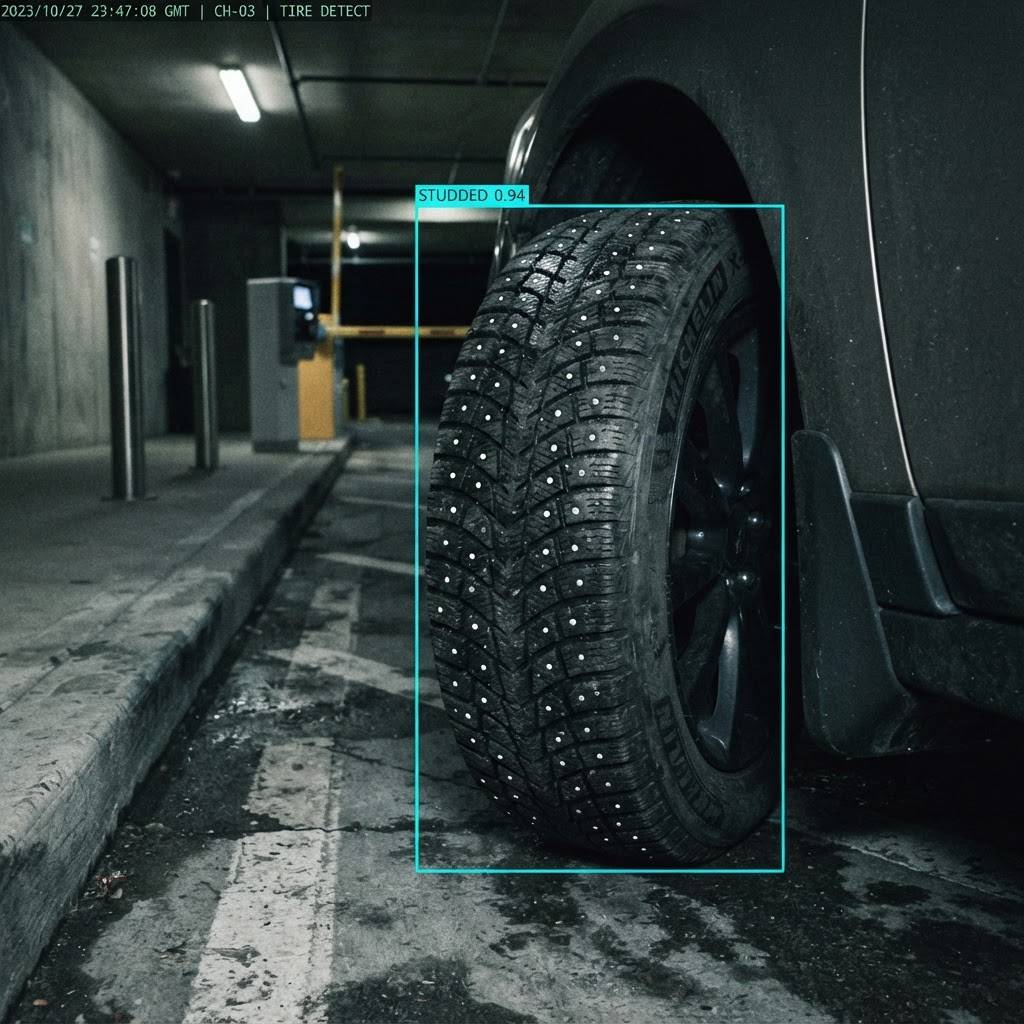
A vision model trained specifically on stud patterns scores each wheel against a confidence threshold.
- 03
Decide
Studded, non-studded, or undetermined — resolved per vehicle, with no bottleneck at the gate.
- 04
Acts at the gate
On a studded read it can show feedback on the entry system’s own lane hardware and drive the swing arm to hold or deny entry. Enforcement is optional — detect-and-log-only mode is fully supported.
A system that knows when it's unsure.
The model doesn't guess. Below the confidence threshold, a frame is simply marked undetermined — protecting guests from a wrong call and your property from acting on a bad read.
Flagged. Routed to whatever policy your property applies — surcharge, notice, or restricted access.
Cleared. The vehicle proceeds with no delay and no friction at the gate.
Held for review. Confidence too low to call — the system waits rather than making an accusation it can't back up.
Field-Tested, Not Theoretical
Built and proven at a real entrance.
Stud Striker isn't a lab demo. The detection model, the confidence thresholds, and the gate integration were validated on live traffic — in winter, in varied light, and against a major parking operator's own hardware.
Tested in the conditions that matter
We ran Stud Striker through real winter weather and a range of lighting — daylight, dusk, night, glare, and snow on the lens. When a frame is genuinely hard to read, the system returns undetermined instead of a bad call.
A decision before the car stops
Each approaching vehicle is categorized from the camera feed in a second or two, with a high-confidence studded / not-studded result — fast enough to act on at the lane, not minutes later in a report.
Proven against real gate hardware
In a proof-of-concept with one of the largest parking systems, a studded detection dropped the entry arm and pushed a message to the operator’s existing lane screens — no new signage, no rip-and-replace of the gate.
It gets sharper with every vehicle.
The images captured at your lane feed back into training. Each new batch of real-world data retrains the model on the exact conditions at your site — steadily raising confidence and closing the gap on false positives over time, rather than freezing at day-one accuracy.
- 1–2s
- From camera frame to a studded / not-studded call
- 3
- Outcomes per vehicle: studded, not studded, undetermined
- Winter
- Field-tested through real snow, glare, and low light
- POC
- Integrated with a major parking system to drive the arm and lane screens
Configured, not custom-coded.
Stud Striker ships as a single configuration file. Pointing it at a new lane, camera, or facility is a config edit, not a development project. It works with IP streams, USB webcams, Raspberry Pi cameras, and most gate hardware you already run. Every install is tagged by building, entry, and lane — one config, one identity, fully auditable.
Fleet health at a glance — each unit reports CPU, memory, network, and detection activity to a live dashboard, so a stalled camera is caught before it becomes a gap in coverage.
The numbers that actually run your operation.
Every lane reports the metrics a property manager cares about — how many vehicles came through, how confidently each was classified, and how many studded tires were caught. No server graphs, just the business picture.
4,204
this week
6.3
frames analyzed per pass
424
10.1% of traffic
3,709
88.2% of traffic
1,180 ms
camera frame to classification
Detection outcomes by day
Studded, not studded, and undetermined reads
Vehicle volume by hour
Representative weekday traffic
Priced per lane — the way it's deployed.
One camera, one config, one lane. Pricing scales with coverage, not with vehicle volume — a quiet lane and a busy lane cost the same.
Single Lane
$399USD/month
One camera, one lane — full detection, logging, dashboards, and support. Ideal for a pilot.
- One camera, one monitored lane
- Full detection & three-state decisions
- Timestamped logging and audit trail
- Live business metrics dashboard
- Setup, tuning, and support included
Multi-Lane
$299USDper lane/month
For properties running multiple lanes or buildings — same capabilities per lane, shared dashboards across the fleet.
- Every capability of Single Lane
- Per-lane rate for each added lane
- Shared dashboards across the fleet
- Multi-building / multi-entry tagging
- Priority setup and support
Not sure yet? Start with a single-lane pilot and scale property-wide from the same config format.
Questions, answered.
Usually not. Stud Striker works with common IP streams, USB webcams, and Pi cameras. If your gate already has a camera, we can likely use it.
Put Stud Striker to work at your property.
Start with a pilot at a single lane and scale property-wide — protecting your pavement, your budget, and your record.
- info@kalkul.ca
- Location
- Halifax, Canada
- Website
- kalkul.ca